Partitioning and Clustering Strategies for CDC-Fed Warehouse Tables
CDC writes demand different partitioning and clustering strategies than batch loads.
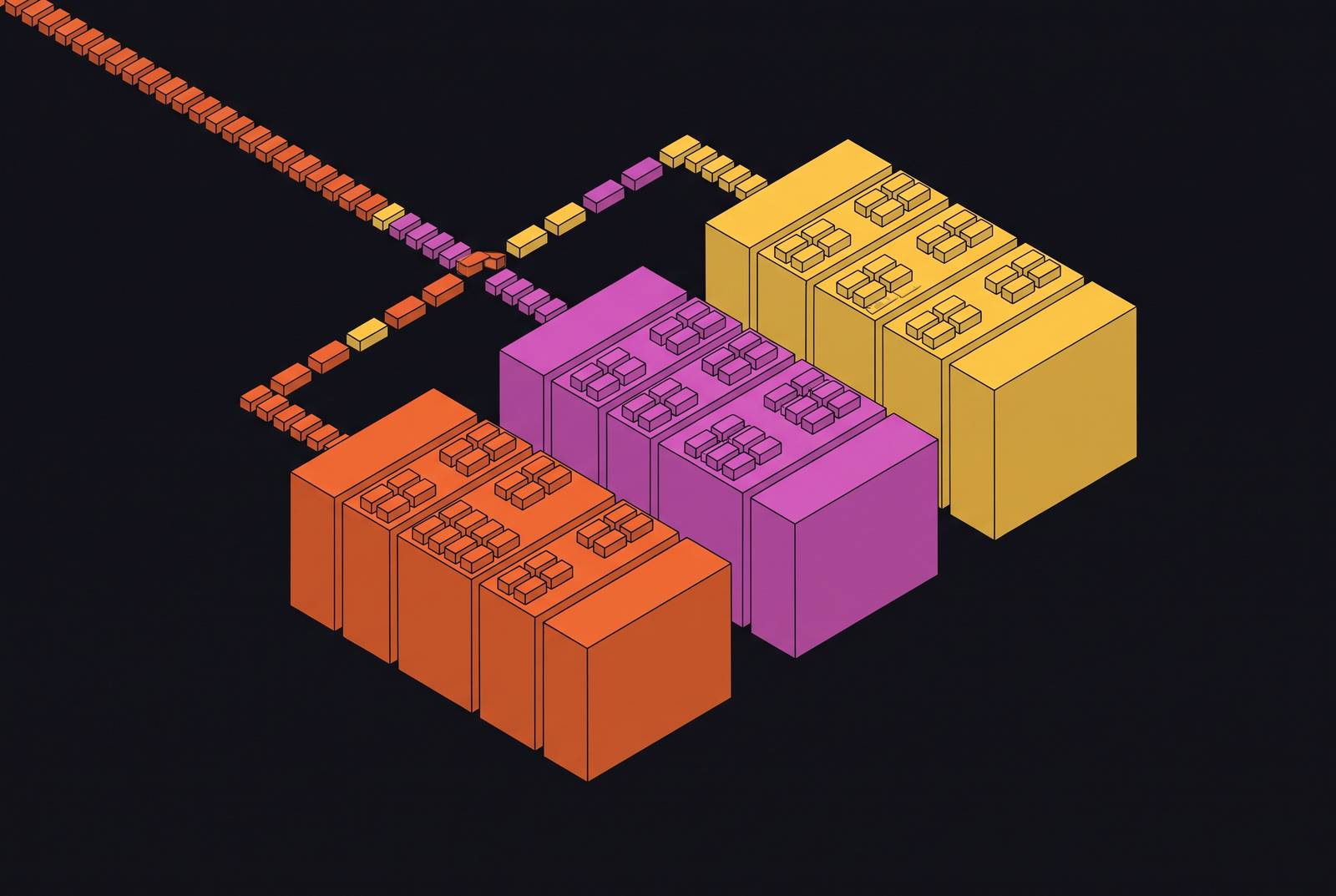
Change data capture inverts the write pattern that most partitioning and clustering guidance was written around. Instead of large, periodic, time-ordered loads landing in predictable places, CDC delivers a constant stream of small, individually committed row changes, and the physical layout rules built for batch simply don't hold under that pressure.
Why CDC writes break the assumptions behind standard partitioning advice
Log-based CDC reads every insert, update, and delete straight from the source database's transaction log, and it streams each one to the warehouse as it happens. A batch extract reads the full table on a schedule, in bulk. CDC produces a steady trickle of individual row-level events instead, and those events carry no regard for which partition or cluster they ought to land in. Rows arrive in commit order: whatever sequence the source database happened to process them in, which has nothing to do with customer, product, region, or any other column a data team might choose to organize around.
This creates a problem batch pipelines never had to solve. A batch load only adds rows, in large chunks, once a day or once an hour. CDC does something different: it can touch the same row, and therefore the same partition, repeatedly within a short window, as the source system issues an insert, then two updates, then a delete, all against one record in the span of minutes. Each of those events forces a file rewrite or a merge against a partition that was already written, sometimes just seconds earlier. A table that performed well for a year of nightly batch loads can develop hundreds of tiny files per partition within weeks of switching to CDC, because every micro-batch writes a small file into whichever partition its handful of rows happens to belong to. File count grows faster than row count, and nothing about the original partitioning design anticipated that.
What partitioning actually does, and where its limits appear under streaming writes
Partitioning exists to make partition pruning possible: a query that filters on the partition column can skip every partition that doesn't match. That benefit is visible only when writes themselves respect partition boundaries in a way that lines up with how later queries will filter. Batch loads tend to do this naturally. A nightly batch of yesterday's orders lands cleanly in yesterday's partition, because the extract itself is bounded by date.
Range partitioning on a date column is the default choice for analytical tables, and for good reason: when analysts filter by date, the engine scans only the matching partitions and ignores the rest. The approach depends on writes arriving in something close to time order. CDC doesn't offer that guarantee. An update to a three-year-old order lands in the partition for three years ago, not in today's partition, because CDC events carry the entity's full history with them. Date partitioning works when queries filter by event date and writes arrive in roughly that order. When CDC delivers updates keyed by entity, by customer, order, or device, rather than by when the update happened to occur, date partitioning scatters those updates across years of historical partitions instead of consolidating them.
Hash partitioning on an entity key avoids that scattering by routing every write for a given customer_id to the same partition, regardless of when the write arrives. It trades away the one thing range partitioning is good at: a query filtering by date now has to touch every partition, because the hash function spreads sequential timestamps across buckets with no regard for order. For a table whose dominant query is "what does entity X look like right now," hash partitioning will generally outperform date partitioning. For time-series analytics, it's a clear regression.
Date partitioning under CDC also tends to produce a persistent write hotspot: nearly all current inserts target the latest partition, while older partitions quietly accumulate a slow drip of small update files from backfills and corrections. Static date partitioning can hurt query performance rather than help it once it produces a large number of small partitions, and CDC is exactly the kind of workload that generates many small writes per partition on every micro-batch interval. Tables built from fewer, larger partitions consistently outperform tables fragmented into many small ones, which is the opposite of what CDC ingestion produces left unmanaged. Partition pruning pays off only when the physical layout matches the write pattern, so CDC's write pattern is the one standard partitioning advice was never built to handle.
How clustering degrades over time under continuous CDC writes
Clustering works by sorting rows within files along a chosen column, so that each file's min/max range, its zone map, stays narrow. A file where customer_id spans the entire entity range can't be skipped for any customer-specific query. A file where customer_id spans a narrow band can be skipped for most of them. That narrowing is the entire mechanism behind clustering's performance benefit.
CDC writes undermine that mechanism continuously, not just once. Events land in whatever order the source database committed them: an insert for one customer, an update for a completely unrelated customer, a delete for a third, all in the same micro-batch. Each new file written this way contains a near-random sample of the entity space, which maximizes its min/max range and erases the zone-map benefit clustering was supposed to provide. A table that started out well-clustered, perhaps from an initial backfill sorted carefully by entity key, degrades steadily as CDC micro-batch files pile up around that original sorted data. Within weeks, the table behaves as though it had lost all of its original clustering.
Delta Lake on Databricks automatically clusters unpartitioned tables by ingestion time, which gives time-series queries partition-like pruning without any manual tuning. That default assumes queries filter by when data arrived. CDC-fed tables are usually queried by entity instead, by customer, order, or device, and ingestion-time clustering fails to match that access pattern. Teams running analytics against CDC tables generally need to replace it with explicit clustering on the entity key.
Reclustering an ingest-heavy CDC table once, at setup, solves nothing on its own. Because every subsequent micro-batch degrades clustering order again, reclustering has to run as an ongoing background process scheduled against the pipeline, not a step performed once when the table is first built.
Partitioning and clustering strategies that hold up under CDC write patterns
The strategies that actually work under CDC share one design principle: they organize physical layout around how entities get queried, and they treat file compaction and reclustering as recurring pipeline work.
Databricks recommends liquid clustering for all managed tables, including tables under concurrent write load, and the approach works across both low- and high-cardinality columns. It avoids the fixed partition boundaries and small-file accumulation that come with static partitioning, both of which are especially damaging under CDC. For Unity Catalog managed tables built on Apache Iceberg, Unity Catalog supports only liquid clustering, and it treats PARTITION BY columns as clustering keys directly. Teams migrating a Delta Lake table from static partitioning to liquid clustering do that conversion with ALTER TABLE... REPLACE PARTITIONED BY WITH CLUSTER BY. For managed Iceberg tables, that same conversion step is unnecessary and will raise an error, since Unity Catalog already interprets PARTITION BY columns as liquid clustering keys on those tables.
What makes liquid clustering suited to CDC specifically is that it decouples the clustering key from fixed partition boundaries, letting the engine recluster incrementally in the background instead of rewriting an entire partition every time new data lands. That's the exact capability a continuously written CDC table needs: incremental correction rather than periodic full rewrites. Databricks notes that teams running a high volume of UPDATE or MERGE statements, the typical CDC merge pattern, should apply liquid clustering on a column matching ingestion order, such as an event timestamp or creation date, specifically to preserve ingestion-time clustering through heavy merge activity.
Partitioning is sometimes the wrong call from the start. Most tables on Databricks under 100 TB don't need explicit partitioning at all, since Delta Lake's automatic ingestion-time clustering on unpartitioned tables already delivers partition-like performance without manual tuning. For CDC-fed tables under that threshold, skipping explicit partitioning is frequently the better choice. An ineffective partitioning scheme on a large table can require a full data rewrite to correct, so teams should confirm that queries actually filter on the proposed partition column, and that the table is large enough to benefit, before adding a date partition out of habit.
BigQuery handles the CDC pattern through a combination rather than a single mechanism: partition on the event or updated_at timestamp to limit scans for time-range queries, and cluster on entity keys like customer_id or order_id to get file-level pruning within each partition for entity lookups. That pairing covers the two query patterns that dominate CDC-fed tables: pulling all changes within a recent window, and pulling the current state of one customer.
Snowflake organizes data into micro-partitions automatically on every table. For CDC-fed tables, enabling automatic clustering on the most selective query columns, and scheduling regular CLUSTER BY maintenance, keeps micro-partition overlap low as new CDC batches continue to land.
Redshift controls physical layout through sort keys and distribution keys. For CDC-fed tables, choosing a sort key aligned with the most common filter column, often a timestamp or an entity ID, and running VACUUM after high-volume merge windows, keeps the table sorted and keeps its zone maps useful.
The pattern that resolves the underlying tension most completely splits the table in two. An append-only event table captures every CDC event along with its operation type and timestamp, and it's built for time-series and audit queries. A separate current-state table, maintained through MERGE, serves entity lookups. Each table can then be partitioned and clustered independently, for its own access pattern, rather than forcing one physical layout to serve both the write-optimized append pattern and the read-optimized entity-lookup pattern at once. Separating those two problems, write optimization for the event log and read optimization for current state, removes the compromise that a single merged table design otherwise forces.
Schema evolution's effect on partition and clustering stability
Source databases change their schemas, and when the column that changes is also a partition key or clustering key, the warehouse table built on top of it runs into a layout conflict that no amount of query tuning resolves without a rewrite. Schema evolution has to be treated as an input to partitioning design from the start, not a problem to deal with when it eventually happens.
CDC mechanisms capture row-level data changes reliably, but DDL statements, an ALTER TABLE, a column rename, a type change, aren't propagated automatically by every CDC mechanism. When that propagation gap exists, the pipeline keeps writing events under the schema it last knew about while the warehouse table has already moved on, or the reverse: the table lags behind a schema change the source database already made. Either direction leaves the pipeline and the table disagreeing about what a row looks like.
Adding a nullable column is the safest schema change, and modern managed CDC platforms broadly support it, though native CDC implementations, SQL Server's native CDC among them, can need manual reconfiguration to pick it up. The safe sequence adds the column to the source database first, updates the schema inside the CDC pipeline next, and only then starts writing meaningful values into it. Consumers that haven't been updated to expect the new column just get nulls, and they keep running without failure.
Renaming or dropping a column that also serves as a partition key is a different category of change entirely, and a destructive one. Existing partitions were written under the old key name. New data arrives tagged with the new name. The engine can no longer reliably prune across that boundary, because it's effectively looking at two incompatible partitioning schemes stitched into one table. Any rename or drop touching a partition column should be treated as a full table rebuild, planned as such, not patched around.
That determines which columns get chosen as partition or clustering keys. Status flags, legacy identifiers, and application-specific codes are exactly the kind of columns developers rename or deprecate over a system's lifetime. Even when such a column appears in most of today's queries, building the physical layout of a CDC-fed table around it invites a full rewrite the moment someone on the source-system side decides to clean it up.