Real-Time Data Warehouse Architectures for Operational Analytics
Solving the ingestion bottleneck that makes real-time analytics actually work.
Real-Time Data Warehouse Architectures for Operational Analytics.
Why operational analytics demands a different warehouse architecture
Real-time data warehouse architecture for operational analytics lives or dies on one layer that most comparisons skip entirely: ingestion. The platform matters, but the platform is not where the promise of sub-second answers gets kept or broken. That happens upstream, in how operational database changes reach the warehouse in the first place, and it's the subject this piece maps in full, from source database through replication to the warehouse itself.
For years, the working assumption behind what got called the "Modern Data Stack" was that a warehouse handled batch BI, and if a team needed anything faster, it bolted on a separate speed layer. That arrangement was never free. ClickHouse's published comparison of the field frames 2026 as the year that dual-stack assumption gets retired, with the goal being a single architecture that handles both batch and real-time workloads without the seams showing. That unification is only real, however, if the pipe feeding the warehouse can keep pace with the promise.
Operational analytics, defined precisely, means analytics computed within milliseconds to minutes of an event happening, rather than the next morning. It's what powers analytics performed within milliseconds to minutes of an event occurring (dashboards, AI agents, A/B tests, and customer-facing features), not end-of-day reporting. That's a fundamentally different demand than end-of-day reporting, and it exposes a tension baked into how cloud warehouses were built in the first place: their foundational design choices optimized for operational simplicity in batch analytics, and ClickHouse's engineering analysis is blunt about the consequence, that same choice now imposes real limits on ultra-fast queries, real-time ingestion, and streaming workloads.
This isn't a niche concern for teams chasing an edge case. Confluent's 2025 Data Streaming Report, surveying 4,175 IT leaders across 12 countries, found that 86% of organizations now consider real-time data streaming a critical or highly important strategic priority. The ingestion layer is the load-bearing component that most platform comparisons skip, with continuous CDC-based ingestion in particular going unexamined. That dual-stack model produced real costs: data duplication, inconsistent metric definitions, spiraling TCO from redundant compute and storage.
How modern cloud data warehouses are structured
That's not a cosmetic engineering choice.
The architecture pays off in three concrete ways. It gives elastic scalability, letting a team spin up a large compute cluster for a heavy transformation job and shut it down the second it's done. It gives workload isolation, since multiple independent compute clusters can query the same underlying object store at once without stepping on each other. And it gives stateless resilience: because the data itself persists in object storage rather than on the compute node, a failed node gets replaced instantly with no data loss.
Five platforms dominate this landscape in 2026, according to ClickHouse's published comparison: Snowflake, Google BigQuery, Amazon Redshift, Databricks, and ClickHouse Cloud. They diverge sharply, though, on a dimension that matters as much as raw performance: how open or closed the underlying data format is. Snowflake and BigQuery store data in closed, proprietary formats, micro-partitions and Capacitor respectively. Moving that data anywhere else carries a real computational cost. Databricks takes a more open stance, built on open table formats, Delta Lake and Iceberg, and open-source components such as Spark, though the platform itself is not self-hostable. ClickHouse Cloud is a managed service wrapped around the open-source ClickHouse engine, the same engine that runs in the cloud also runs on a laptop or on self-managed infrastructure, a genuinely different posture from the others.
This is what matters. All five platforms were built to excel at batch BI first. Storage-compute separation is table stakes across the board at this point, so it isn't where any of them actually differentiate on real-time performance. What separates them under concurrent, low-latency load is the ingestion path and how the query engine behaves when dozens or hundreds of small, fast queries hit it simultaneously, not whether storage sits apart from compute. Understanding what these five platforms are good at is only half the picture. The harder, less-discussed question is how operational database changes actually get from a production system into any of them fast enough to matter. The defining characteristic of all major 2026 platforms is decoupled storage and compute, with object storage (S3, GCS, Azure Blob) as the primary persistence layer.
Where batch ingestion breaks down under real-time demands
Batch ETL, the pattern that has run data pipelines for decades, works by scheduling full or incremental extracts on a timer, typically hourly or overnight, then bulk-loading the results into the warehouse.
Data in the warehouse is only as fresh as the last batch run, which puts it anywhere from minutes to hours behind the source system. Extraction itself creates load, since a full-table scan against a production database competes directly with the traffic that database is supposed to be serving. Schema fragility is a quieter problem, batch jobs tend to break, sometimes loudly and sometimes silently, the moment a source schema changes underneath them, and someone has to notice and fix it by hand. And batch extracts routinely miss deletes altogether, whether soft or hard, because a scheduled snapshot has no natural way to represent something that's now gone.
The consequences aren't abstract. An AI agent that queries a warehouse full of stale data produces answers that are wrong in ways that are hard to detect until they've already caused damage, and a dashboard built on hourly snapshots simply cannot support a decision that depends on knowing what's true right now. The economic argument for fixing this has already been made by practitioners rather than vendors: Confluent's 2025 report found that 44% of organizations surveyed report a 5x return on investment from real-time streaming initiatives. That's not a marketing claim, but an aggregate figure from IT leaders: per Confluent's 2025 Data Streaming Report, surveying 4,175 IT leaders across 12 countries, 86% of organizations now view real-time data streaming as a critical or highly important strategic priority.
None of this means the warehouse is the problem. The fix isn't replacing Snowflake, Google BigQuery, Amazon Redshift, Databricks, or ClickHouse Cloud, it's repairing the ingestion layer feeding them. The name for that pattern is Change Data Capture, CDC: capture every insert, update, and delete straight from the source database's transaction log and stream only those changes, continuously, rather than re-reading the whole table on a timer.
Why log-based capture is the standard for CDC
CDC, at its core, continuously identifies inserts, updates, and deletes happening in a source system and propagates only those changes downstream, never a full table scan, never a scheduled snapshot. That distinction is the entire point. A batch job asks "what does this table look like right now" over and over; CDC asks "what changed since the last time I looked" and answers that question as events happen.
There are three ways to detect those changes, and they are not interchangeable. Query-based polling, checking a last-modified timestamp column on some interval, is the easiest to bolt onto an existing system, but it has real blind spots: it can't see hard deletes at all, it adds repeated query load to the source database, and its latency is bounded by however often the poll runs.
Change Data Capture (CDC) captures every insert, update, and delete from the source transaction log and streams only those changes, continuously. A system reading the transaction log isn't competing with production traffic for query capacity, it's reading a stream the database was already writing for its own durability guarantees. Nothing about the source needs to change to support it, no new columns, no new triggers, no altered application code.
Getting the mechanism right doesn't mean the rest of the pipeline is free of engineering decisions. A busy production database can emit thousands of change events per second, and whatever sits downstream of the log has to absorb that throughput without falling behind, applying backpressure or buffering when consumers slow down rather than dropping events. End-to-end latency needs to be measured honestly too, as the sum of capture, transport, and apply, and the p95 and p99 tail, not the average, is what actually makes a dashboard feel real-time. Even the choice of serialization format carries weight: JSON travels everywhere and is easy to debug, but binary formats shrink payload size and cut the CPU cost of encoding and decoding at volume. And because capturing the change stream from a production database is the most expensive step in the whole chain, the sound architectural pattern is to do it once and fan the resulting stream out to however many destinations need it, warehouse, data lake, downstream application, through a buffering layer, rather than reading the source log repeatedly for each consumer. There are three detection mechanisms and their tradeoffs. Trigger-based approaches write to audit tables via AFTER INSERT/UPDATE/DELETE triggers, and are generally avoided at scale due to write amplification on the source database.
How each major source database exposes changes
Every major operational database exposes its change stream differently, and the differences aren't cosmetic. They shape what a CDC pipeline has to handle explicitly rather than assume.
PostgreSQL uses logical decoding to extract changes from the write-ahead log, and what makes it flexible for downstream consumers is that the decoded changes are SQL-level, INSERTs, UPDATEs, and DELETEs, independent of the physical storage format. That stream is only usable because of replication slots, a bookmark called restart_lsn that tells Postgres not to purge WAL segments until the consumer has actually processed them. That safeguard is also the sharpest operational risk in the whole system: a replication slot that's abandoned, or a consumer that falls behind and never catches up, will cause WAL to accumulate on disk until it fills the volume, and monitoring slot lag deserves the same alerting rigor most teams already give to query performance. Getting logical replication running at all requires explicit configuration: wal_level has to be set to logical, and both max_replication_slots and max_wal_senders need to be raised above their defaults, with max_slot_wal_keep_size, available since Postgres 13, acting as a safety ceiling against runaway disk use.
Postgres's logical replication capability has moved fast. Version 10 introduced it, version 15 added row and column filtering on publications, version 16 added the ability to decode from a standby server and apply changes in parallel, and Postgres 18, released in September 2025, made parallel streaming the default behavior, began replicating generated columns, and added conflict logging; Postgres 19 was in beta as of mid-2026. On managed platforms the friction is lower than it looks: AWS RDS handles the wal_level change automatically once rds.logical_replication is set to 1 and the instance reboots. One gotcha deserves particular attention because it's a non-obvious production issue: TOAST columns can omit unchanged large values from the WAL, and a pipeline that doesn't handle that explicitly can corrupt downstream data.
MongoDB takes a different approach, built on the replica set oplog, where consumers subscribe through an aggregation pipeline and receive a stream of change events. Resume tokens let a consumer restart from an exact position without missing anything, though that guarantee only holds within the oplog's retention window.
DynamoDB works differently still. DynamoDB Streams captures changes at the individual item level, in near real time, rather than exposing anything resembling a transaction log. That stream is what feeds changes into a warehouse, a data lake, a vector database, or a search index downstream.
The pattern across all three systems is the same even though the mechanics differ completely: every database offers a different replication contract, and a production CDC pipeline has no choice but to handle initial snapshots, resume and restart semantics, and each source's particular edge cases explicitly. There is no generic implementation that works identically across Postgres, MongoDB, and DynamoDB. Anyone claiming otherwise hasn't operated one of these pipelines through an incident. Decoding plugins include pgoutput (built-in, supported on Cloud SQL), wal2json (streams changes as JSON), and test_decoding, and the choice of plugin affects downstream format handling.
Schema evolution: the ingestion problem most architectures don't solve until it breaks them
Source databases change shape constantly. Columns get added, renamed, dropped, or retyped, and that happens on whatever cadence application development moves at, which has nothing to do with the schedule a data team would prefer.
Batch ETL's answer to this is blunt: the job simply fails at extract or load, someone gets paged, and the pipeline gets patched by hand before it can run again. Naive CDC isn't actually much better, it just fails more quietly. A change event appears with a field that's new or missing in the source, and the consumer either errors out, silently drops the unfamiliar column, or writes malformed records into the warehouse.
Solving this properly means the pipeline has to detect column additions, type changes, and removals directly in the change stream itself, then propagate those changes into the warehouse's destination schema without a human in the loop, all while preserving history so that, say, a renamed column doesn't orphan every record written before the rename. That requirement interacts directly with how a warehouse models historical change. Type 1 slowly changing dimensions overwrite records in place; Type 2 dimensions append a new versioned record and keep the old one intact, and each pattern has genuinely different requirements for how a schema change should propagate through it. The replication layer has to know which pattern it's feeding.
This is why schema evolution belongs at the center of the architecture rather than treated as an edge case to patch later. A replication system that needs a person to intervene every time a source schema shifts cannot run unattended at the pace operational analytics demands, and it quietly reintroduces the exact human-in-the-loop delay that CDC exists to eliminate in the first place. A pipeline that delivers every single change correctly but corrupts records the moment a schema changes has, in practice, the same failure mode as a pipeline that loses data. Both leave the warehouse holding numbers nobody should trust.
Where CDC tooling options leave work for the team
The CDC tooling landscape doesn't divide neatly by feature checklist. It divides by operational model, self-hosted open source, fully managed SaaS, cloud-native services tied to a specific provider, and hybrid approaches that mix elements of each, and that distinction determines cost and complexity as much as any feature comparison does.
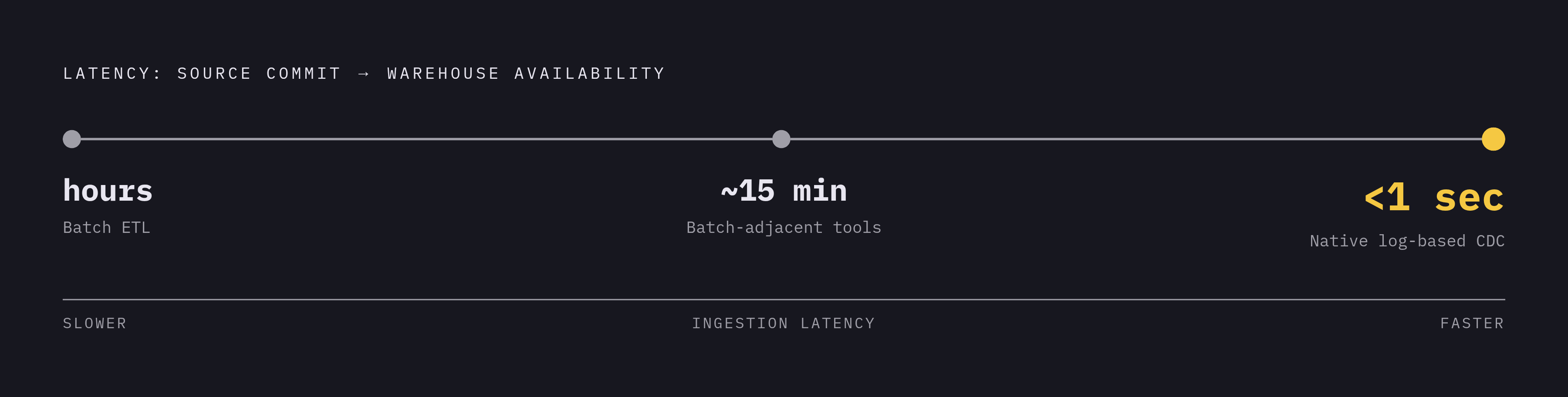
Latency is the sharpest dividing line. Native log-based CDC platforms deliver changes in well under a second from commit; batch-oriented tools, even ones marketed as "real-time," can run closer to a quarter-hour or more. That gap decides whether a given warehouse setup can support an operational use case. Pricing is just as fragmented: some tools charge per connector, some per row processed, some by monthly active rows, some on raw usage, and total cost of ownership tracks data volume and team size far more than it tracks the number printed on a pricing page.
One well-known open-source approach in this space reads transaction logs directly and can deliver row-level change events in under a second from the moment of commit, with connectors covering PostgreSQL, MySQL, MongoDB, SQL Server, Oracle, and Db2 among others as of 2025. Recent versions of this style of platform have improved exactly-once delivery guarantees, added incremental snapshotting that doesn't require locking tables during the initial load, and added native support for Kafka's KRaft mode, which becomes mandatory starting with Kafka 4.0. Running this kind of setup means a team is also signing up to build, operate, and keep alive a Kafka and Kafka Connect cluster, and that operational burden is not small. It suits engineering organizations set on owning a fully custom, open-source CDC and event-streaming stack for the long haul, with the staffing to match.
Fully managed, closed-source platforms sit at the other end of the spectrum, offering CDC with no ability to customize its internal behavior, which is a fair trade for teams that want managed simplicity and aren't yet running into cost ceilings driven by data volume. Cloud-native options such as AWS DMS integrate tightly with a single provider's ecosystem, which makes them a practical, low-assembly choice for teams already fully committed to that cloud, though a poor fit the moment multi-cloud or cross-cloud replication enters the picture.
What ties all of this back to the earlier argument is straightforward. None of these tools make the warehouse choice irrelevant, but every one of them proves the same point: the ingestion layer, not the query engine, is what decides whether "real-time" is a real property of the system or a claim on a slide. Managed real-time replication services exist as an alternative to assembling Kafka and Debezium or accepting batch-adjacent latency. Choosing among them means being honest about what a team is actually equipped to operate, beyond what a benchmark chart claims it can do.
Sources
- Top 5 cloud data warehouses in 2026: Architecture, cost, and open-source
- What is Change Data Capture? CDC Fundamentals | Conduktor
- CDC (change data capture)—Approaches, architectures, and best practices
- Log-Based vs Query-Based CDC: Comparison | Conduktor
- Change Data Capture (CDC): Practical Design, Patterns, and Pitfalls in 2026 – TheLinuxCode
- Resilient Data Pipelines: Schema, Errors & CDC | Matia
- Schema Evolution in Change Data Capture Pipelines