Replacing Break-Fix Pipeline Maintenance With Continuous Schema Adaptation
Automatic schema evolution lets CDC pipelines adapt without stopping consumers.
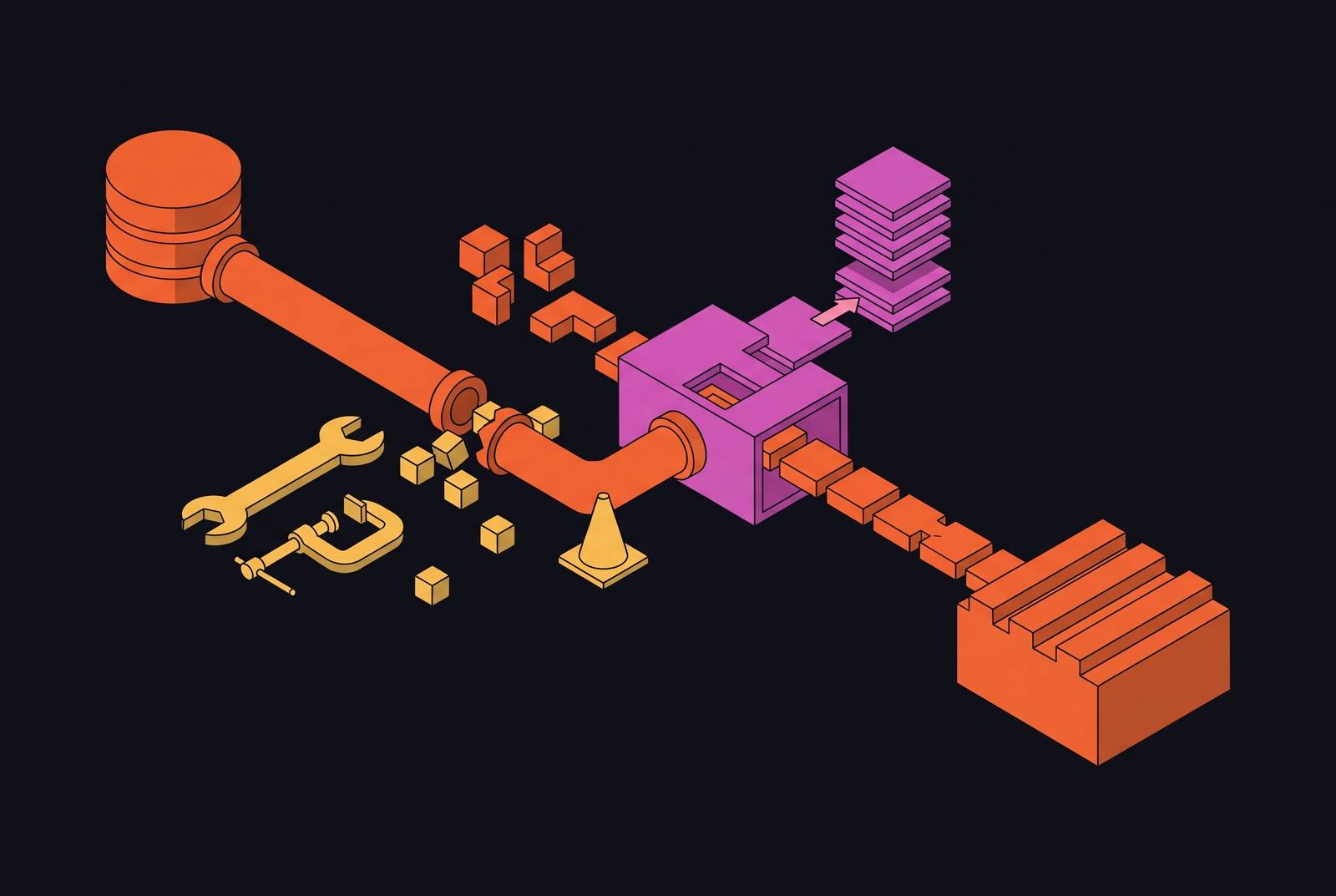
Automatic schema evolution for live CDC pipelines requires versioned schemas, schema-aware consumers, and delivery guarantees that survive changes and retries. Compatible changes can flow without stopping consumers, while incompatible changes become explicit decisions. Replacing break-fix maintenance with continuous schema adaptation therefore means changing the pipeline’s design.
Why data pipelines break on schema changes — and why they keep breaking
An engineer gets paged at an odd hour because an upstream team renamed a column. A transformation no longer recognizes the field, so the engineer investigates, patches the mapping, and runs a backfill. Service returns, but the underlying weakness remains. The pipeline still assumes that its source schema will stay fixed, even though renaming fields, changing types, and dropping columns are normal acts of product development.
Across more than a handful of pipelines, schema drift becomes continuous background noise. Each patch repairs the transformation that failed without giving the pipeline a way to represent the next schema change. Investigation, patching, and backfill then consume engineering time that would otherwise go toward features or infrastructure improvements.
What log-based CDC actually captures — and why that makes schema change visible
Log-based change data capture reads the database’s native transaction log. It adds no load to the source query executor and requires no source schema modifications. Its unit of work is the change event. A structured event represents the before state, which is null for inserts, the after state, which is null for deletes, the operation type, and metadata including timestamp, transaction ID, and source position.
This granularity preserves changes that batch extraction collapses. When a row is updated five times between polling intervals, it produces five events instead of one record that shows only its latest state. Log-based CDC also captures deletes and preserves operation order. A schema-aware consumer can therefore see changes in event structure, though the database may still need help to replicate each schema definition change.
PostgreSQL uses logical decoding of the Write-Ahead Log, or WAL, to turn changes into logical messages that it delivers in commit order. That ordering gives consumers a defined sequence to process. MySQL and another relational database use the binary log, while MongoDB provides Change Streams on replica sets or sharded clusters from version 3.6. A standalone MongoDB instance cannot stream because it keeps no oplog. DynamoDB Streams similarly exposes item-level changes without waiting for a batch cycle.
Trigger-based CDC writes changes to a shadow audit table, so its write overhead grows in proportion to the volume of changes, and schema changes can break the triggers themselves. Timestamp-based polling queries source tables on a schedule but misses deletes and intermediate states. Its schema handling happens later, during transformation. Log-based capture supplies the event stream that continuous adaptation needs, but consumers must still know how to interpret it.
How schema changes break CDC consumers — the three failure modes that dominate production incidents
Detecting a changed event structure does not make a consumer compatible with it. A new column, renamed field, or changed type can cause consumer failure, silent truncation, or unnoticed drift downstream. Without explicit schema handling, a live pipeline can fail as predictably as a batch pipeline, only faster and sometimes less visibly.
Three production failure modes expose the gap between capture and reliable operation. First, a connector can fall so far behind that the database recycles the transaction log before it catches up, and it loses the source position it needs to recover missing data. PostgreSQL retention controls such as wal_keep_size or replication slots address that risk. Second, a bulk UPDATE without a WHERE clause can flood the queue with millions of events and exhaust connector memory. Rate-limiting parameters are necessary because CDC is deceptively simple in theory and brutally complex in production.
Third, a schema change can break deserialization when old consumers encounter new-schema events. An ALTER TABLE ADD COLUMN, especially involving a NOT NULL column without a default, can expose this mismatch. A schema registry with evolution support, such as Avro, allows old and new event formats to coexist. Compatibility must precede use of the new field. The practical sequence is to add the column, update the registry, update consumers, and begin writing meaningful values only after all consumers are confirmed compatible.
How do you handle upstream schema changes without stopping a CDC pipeline?
An adaptive pipeline propagates schema changes through the same channel as row-level changes, rather than relying on an engineer to discover them after failure. Its consumers recognize versioned structures and can process old and new formats during a transition. This allows producers and consumers to converge without downtime.
A schema registry provides the operational core of that design. It holds versioned schemas for event types and lets producers and consumers check whether their schemas are compatible. When a source column is added and is backward-compatible, consumers can keep using the fields they already use, while updated consumers can also use the new column. No repair is needed for that compatible transition. Connecting the registry gives transformations type safety and automated compatibility checks, so each transformation need not find a mismatch on its own.
An incompatible rename or type change requires a different response. The pipeline surfaces a specific compatibility conflict so an engineer can decide how to route the change. Automation bounds the work by identifying the conflict for that judgment, saving the team the work of diagnosing a failed pipeline and reconstructing its state.
PostgreSQL’s latest major release adds logical replication improvements, including replication of generated columns and sequence values. However, DDL changes still do not propagate automatically through logical replication and must be applied manually on subscribers. Native replication is not automatic schema adaptation. Versioned schemas and compatible consumers remain necessary regardless of database version.
Delivery guarantees and failure recovery — why exactly-once semantics are not optional in an adaptive pipeline
A pipeline that accepts new schemas but silently duplicates or drops events remains unreliable. Most CDC pipelines deliver at least once, which permits duplicates during failure and retry. The required outcome is exactly-once processing of each change. Schema compatibility and delivery integrity must therefore be designed together, rather than treating successful deserialization as proof of correct replication.
Idempotent consumers provide a practical route to that outcome. Each event has a stable, unique identifier, such as a UUID or a hash of message content. Before processing, the consumer checks a fast store such as Redis with a TTL and skips identifiers it has already seen. This addresses duplicate delivery during replay. It complements, rather than replaces, durable offset tracking that lets a crashed connector resume from a known position.
Recovery also depends on preserving the context needed to interpret replayed events. Registry state must be durable and versioned so historical records remain readable. Replication lag needs continuous monitoring because downstream staleness can become data loss if the connector exhausts the WAL retention window. Fan-in adds another ordering problem. Events from different databases can arrive out of wall-clock order, and consumers must handle them in a way that keeps the destination state consistent.
How AWS DMS and similar cloud-native tools handle schema evolution — and where they fall short
Cloud-native replication services make it easier to start CDC, but designs built for migration can add costs when they run continuously. AWS DMS illustrates the distinction between moving data and maintaining an adaptive live pipeline. Schema changes often require manual intervention, while latency can degrade under sustained load. CloudWatch metrics expose that degradation, though proactive alerting is not always present. In failure scenarios where source log files are unavailable, recovery can require a full reload.
Schema handling, sustained latency, recovery behavior, and cross-cloud egress cost affect the ongoing cost of replication. A service that makes it easy to start a migration may still leave the team to make compatibility decisions and do recovery work for as long as it runs in production.
Building a pipeline from transaction log readers, a message bus, and consumer code provides another route, but ownership extends beyond assembling those components. The team must build in schema evolution, exactly-once semantics, failure recovery, and lag monitoring. That work takes months to years and creates infrastructure to operate indefinitely. Reliability is not immediate. A hand-built system rarely reaches the reliability of a purpose-built service on its first attempt.
A managed real-time replication service addresses this ownership cost when schema evolution, exactly-once delivery, recovery, and fan-in are part of its design. These are baseline capabilities. Teams can therefore compare what each option does with what their engineers would still have to build. When buying a tool for continuous adaptation, teams must check whether it can keep delivering changes correctly as schemas evolve, as well as whether it can capture them.
Compliance requirements that make schema change handling a legal obligation, not just an engineering preference
For pipelines handling protected health information, or PHI, lost events can create an audit gap as well as a data problem. HIPAA requires ways to record and examine system activity, while tamper-evident logs across pipeline stages are best practice, with no explicit rule that requires immutable logs. A schema-related outage can interrupt that record. Adaptation and recoverable delivery therefore support compliance controls and operational uptime.
NIST guidance referenced by HHS provides a practical integration baseline including TLS 1.2+ in transit, AES-256 at rest, access control, and audit controls. These controls apply to replication infrastructure and the warehouse. Under the current Security Rule, encryption is an addressable specification. Key management remains essential to availability. Lost keys can make data permanently inaccessible, so key rotation, secure storage in an HSM or cloud KMS, and backup procedures belong in the pipeline design.
HHS/OCR’s January 2025 proposed updates would require encryption of ePHI at rest and in transit, MFA with limited exceptions, and annual compliance audits. Finalization is targeted for July 2027, with compliance deadlines likely in early-to-mid 2028. Meanwhile, because HIPAA and SOC 2 controls overlap, work on access management, encryption, and risk assessment can help meet both sets of controls.
Architecture also determines the scope of that work. Replication infrastructure that buffers or stores customer data becomes a data store with its own obligations, while true passthrough replication minimizes that exposure. For HIPAA-scoped services, a Business Associate Agreement is a legal baseline, while a SOC 2 Type II attestation report is a commercially expected evaluation practice. Neither replaces reliable event handling. A pipeline must still preserve delivery and audit continuity when the source schema changes.
What the engineering team's work looks like after the pipeline can adapt itself
Compatible schema changes no longer page engineers, while incompatible changes call for a decision on compatibility or routing. Engineers gain time for deliberate schema governance, observability, and features previously blocked by stale data. Data contracts reinforce that shift. Formal agreements about schema shape and change notification reduce surprises between producers and consumers and complement automated handling.
Reliable freshness also changes what downstream systems can support. Real-time fraud detection, A/B testing frameworks, and customer-facing dashboards need a warehouse that keeps up with changes in operational data. AI systems using stale data risk unreliable outputs. When a feature store’s online and offline paths use the same source, which is continuously replicated, their shared change stream removes the training-serving skew caused by building each path in batches.
Feature teams can build against a dependable stream. Attention moves from investigating another renamed column to deliberate investment in the systems that depend on current, correctly delivered data.