Schema Drift Detection and Alerting in Production Pipelines
Detect schema changes before they silently corrupt your data warehouse.
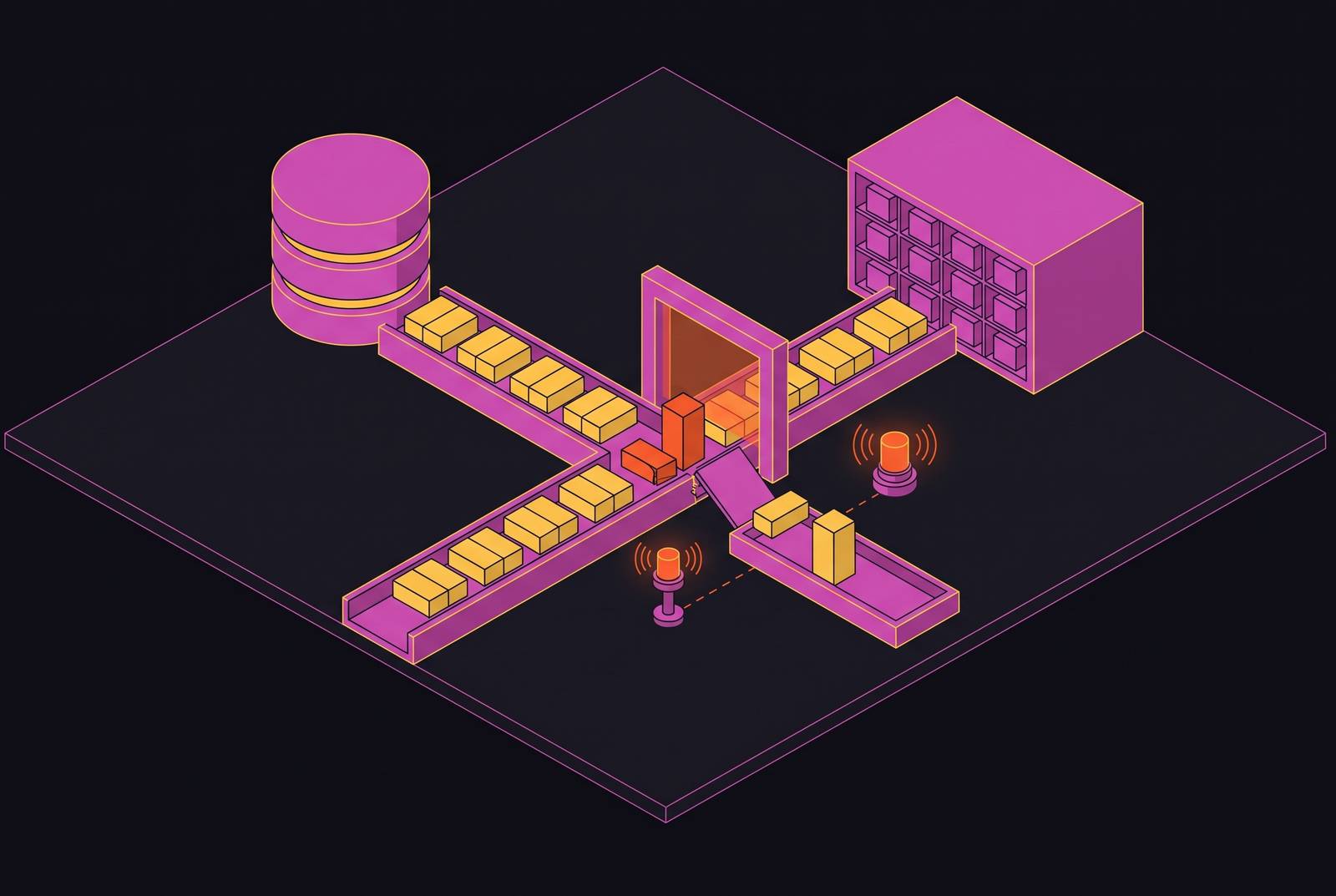
Automatic schema evolution for live CDC pipelines requires a boundary between changes that can proceed safely and changes that need review. Compatible additions and type widenings can be applied automatically, while removals, renames, and breaking type changes need detection, impact assessment, and a controlled response. Schema drift detection and alerting must protect downstream data even when replication reports success.
Why schema drift fails silently and what that silence costs
A Salesforce admin renames a field during routine cleanup, and the nightly sync into Snowflake completes with a green checkmark for three days. Sales ops then discovers that the forecast dashboard’s revenue field has been null for every new opportunity since Tuesday. The job succeeded, but the data did not. Unlike a crashed job that draws immediate attention, this failure persists until a downstream user notices, by which point recovery requires an expensive backfill across a wider damage radius.
An added column can disappear silently if the destination has no place for it, while a dropped column can shift values into the wrong fields in position-based mappings. A rename can leave an empty old column beside a populated new one, and a type change can produce truncated, miscast, or null values. Unity Software’s Audience Pinpointer ML tool ingested bad data from a large customer and lost the value of part of its training data, illustrating the risk when corrupted inputs reach a learning system.
Where schema drift originates and why coordination fails at the source
Source changes usually belong to a different team from the pipelines that depend on them. Application engineers add columns, remove fields no longer in use, or change types with ALTER TABLE statements that object-relational mapping tools generate. SaaS vendors change API fields and response formats, while partners change columns, field order, or delimiters between deliveries. New product attributes, status values, and regions also change how data at the source is structured. Upstream owners rarely all know what depends on their data downstream.
That ownership mismatch makes coordination an incomplete defense. Schema evolution is a change that downstream teams know about and design for, while drift is the same kind of change arriving unannounced from a system they do not control. The pipeline therefore needs to detect changes even when an upstream release process checks for them. The transport cannot supply the missing contract. PostgreSQL logical replication omits DDL commands, MongoDB permits new document fields without a formal migration, and DynamoDB accepts arbitrary attributes without a transport-layer schema warning.
Those differences also affect when a consumer learns that something changed. PostgreSQL sends schema information through Relation messages when data is modified. Downstream consumers may therefore learn of a type change only when a later row write occurs. MongoDB and DynamoDB expose changes to data whose shape must be interpreted by the consumer.
A classification system for schema changes before building detection logic
Change classification needs two dimensions, namely the structural operation and the importance of the affected column. Nullable additions and fully compatible type widenings are candidates for automatic handling. For removals and breaking type changes, a person must review the change before the affected data moves on, while renames need a check of the old-to-new mapping. Compatibility determines the initial response. Downstream dependencies can then require a stronger response even to a small change.
Column additions are not uniformly safe. A new field can be accepted automatically where the destination and consumers allow it, but an addition to a table with strict consumers belongs in a review queue. Type changes need an equally explicit distinction between widening and narrowing. A wider compatible type preserves the required representation, whereas a narrowing or type swap can invalidate values. A rename also deserves separate classification even when its observed signature is a drop plus an add.
Column-level tags make these distinctions operational. “Critical” columns include revenue fields, primary keys, join keys, and fields feeding AI models, while “Optional” columns include supplementary metadata and deprecated fields. The same structural operation can need a faster response depending on that tag. The goal is automated triage. Without this taxonomy, every mismatch produces the same signal, and repeated low-value alerts teach engineers to ignore or disable monitoring.
How to handle upstream schema changes with multi-layer detection
Schema diffing at ingestion provides the first comparison point. The detector keeps a baseline source schema and checks the structure inferred from each run against it before data reaches downstream tables. A name found only in the current schema becomes COLUMN_ADDED, a name from the baseline that is missing becomes COLUMN_DROPPED, and a data_type that has changed becomes TYPE_CHANGED. Renames may appear in schema diffs as an addition paired with a drop. This layer detects structural differences at check time, but it cannot see a DDL operation before the changed structure becomes visible to the check.
Information schema audits and DDL event capture address that blind interval. Scheduled information_schema polling can discover changes that have not yet produced modified rows. For PostgreSQL, DDL event triggers provide another route by capturing CREATE, DROP, and ALTER TABLE events and emitting schema information into the replication stream. This adds an independent source of evidence. It lets the system detect a dropped column before subsequent writes expose the changed table to ingestion.
Canary runs and ingestion validation then test what will actually pass through the pipeline. Before a sync runs, checks compare column names, data types, required fields, and plausible row counts against expectations. An unexpected structural deviation triggers a pause and alert. A review is cheaper than a reconciliation project. This layer complements schema comparisons because a declared structure alone does not establish that incoming records satisfy it.
A schema registry supplies the governance anchor for these checks. In event-streaming pipelines, it defines and enforces evolution rules, while a versioned schema store serves the equivalent role in direct CDC pipelines. Tool selection should distinguish replication continuity from schema handling. AWS DMS can continue replication successfully while silently omitting new fields in some cases, and it does not maintain schema history or version tracking. The relevant criteria are therefore compatible-change automation, validation before data proceeds, actionable alerts, and a record of schema versions.
How Postgres, MongoDB, and DynamoDB each expose drift differently to detection logic
PostgreSQL documentation states that “the database schema and DDL commands are not replicated”. Relation messages expose schema information only when data is modified, so a subscriber may not learn about a column drop until the next write against that table. Detection must cover that delay explicitly. DDL event triggers can get information from pg_catalog, package it as JSON, and send it through PERFORM pg_logical_emit_message(), keeping it in order within the current transaction stream. The pglogical extension offers replicate_ddl_command to queue DDL for execution on subscribers, but it requires careful configuration and compatibility checks.
Pausing a PostgreSQL subscriber introduces another operational risk. Replication slots retain WAL from restart_lsn to the current position, so an offline subscriber whose slot remains can cause WAL to accumulate and fill the primary’s disk. Pauses caused by drift must therefore have a time limit or use max_slot_wal_keep_size to allow slot invalidation. Postgres 17 allows slots marked failover = true to synchronize to physical standbys, removing a class of logical-subscription disruption during publisher failover.
MongoDB needs a different way to detect changes because its flexible documents can gain fields without a DDL event. Change Streams reads changes from the oplog with minimal impact on database performance, and detection must compare event document structures with a stored expected shape. Field-level comparison replaces periodic table-schema polling. However, delete events contain only the document key unless pre-images are available, so they cannot establish a complete document shape. For recovery, Karrot’s use of Apache Flink CDC puts Change Stream resume tokens into checkpoints so it can resume from the recorded position after a failure.
DynamoDB Streams exposes a time-ordered sequence of item-level changes. Detection must compare attribute sets for each item type rather than assume that the whole table has one structure. The team must spell out each expected attribute set and keep track of its versions. The stream does not own that contract. Because arbitrary attribute additions are valid at the source, identifying incompatible changes and assigning their response remains an application-layer responsibility.
Structuring alerts so they produce action rather than noise
An engineer receiving a drift alert needs to know what decision is required and which data is at risk. A message that merely announces “schema changed” leaves the investigation unbounded. Useful alerts identify the table, column, old and new types where relevant, affected downstream consumers, and a link to the lineage graph. Context should arrive with the interruption. Otherwise, the engineer must reconstruct the incident before deciding whether replication can continue.
The lowest routing tier is “Auto-handle and log”. Nullable additions and fully compatible type widenings receive an automatic destination schema update, an event log entry, and an asynchronous notification. “Warn and queue” covers partially compatible type changes and additions affecting strict downstream consumers. That tier pauses the affected stream, alerts its owning team, and requires acknowledgment before resumption.
“Halt and escalate” covers column drops, type swaps, and renames on join-key or revenue columns. Replication stops for the affected table, and an alert goes out at once so a person can decide what to do before data moves on. Channels should reflect those distinctions. Critical alerts belong in PagerDuty or equivalent on-call routing, warnings in a dedicated data platform Slack channel, and automatically handled events in a log reviewed weekly.
Webhook-based integration connects each actionable alert to the existing incident workflow. The incident management system can turn the notification into a ticket, assign someone to own it, and track it through to a fix. The workflow also needs measurable outcomes. Incident count per source shows where drift recurs, time-to-detect measures the interval from DDL execution to alert where applicable, and time-to-resolve measures detection to fix.
The response playbook: what happens from alert to pipeline restored
Quarantining the affected records in a table or dead-letter queue keeps the drifted batch there for review while the pipeline keeps processing clean records. For a critical change, the affected stream or table must still stay stopped as its routing rule requires. Containment limits the scope of the incident. It also separates the decision about questionable records from the health of unrelated downstream consumers.
The on-call decision then follows compatibility and column importance. A backward-compatible change can receive the automatic destination schema update before the pipeline resumes and the ticket closes. A rename on a non-critical column requires mapping the old name to the new name in pipeline configuration and verifying row counts before and after. Critical changes require a different response. For a type swap or drop on a critical column, the engineer holds the stream, contacts the upstream application team to confirm intent, decides whether to backfill or accept data loss from the drift window, and updates the schema baseline and classification registry before resuming.
Prevention belongs in the same operational loop. Expand-contract deployment begins with nullable fields, adds a backfill when needed, and tests schema changes in staging before production. A pre-migration review lets the data platform team compare planned changes against the classification registry and configure their response in advance. That converts unannounced drift into managed evolution. Every schema event, automated response, and human decision should also have a timestamped audit record so there is evidence to help diagnose problems later and meet compliance requirements under SOC 2 or HIPAA.